- Owned by DDW Corp. Limited
- Years in operation 11
- Minimal price per page $10
- Deadline 3 hours
- Revision policy Yes
- Refund policy Yes
Contents
Most reviews of writing platforms read like instruction manuals. Screens, buttons, pricing blocks, and a predictable conclusion that never really explains what it feels like to trust an unfamiliar system with an academic argument. I approached WriteMyPaperBro.com from a different angle – not as a casual user clicking through features, but as someone who has spent years dissecting how academic writing actually works: structure, persuasion, and the subtle difference between a draft that merely exists and a draft that can survive critical reading. Instead of asking “Is this service good?”, the real question became: what happens when the same assignment travels through different hands inside the same platform?
That curiosity turned into a small parallel-reality experiment. One topic, one rubric, one deadline – but multiple writers and slightly different conditions. The goal wasn’t to prove anything or promote a perfect outcome. It was to observe the mechanics: how support responds when instructions get precise, how writers interpret tone differently, and how revision loops reshape a paper after the first draft lands. What follows isn’t a surface tour of WriteMyPaperBro.com – it’s a structured breakdown of how the system behaves when real workflow pressure starts to reveal its patterns.
Pros and Cons (Specific, Non-Marketing)
Pros
- WriteMyPaperBro.com supports meaningfully different outcomes across writers (the writer factor is real).
- Revisions can be productive when requests are specific and targeted.
- Add-ons can increase discipline and accountability (not just “extra files”).
- Workflow visibility is generally stable (files, messages, and steps are easy to track).
Cons
- Writer variance is the primary risk (you may need to switch or revise heavily).
- Support can sound generic on edge-case questions unless you ask very concretely.
- APA “mostly correct” still requires you to verify reference list details.
Assignment Setup (Same Inputs Across All Realities)
- Service: WriteMyPaperBro.com
- Paper type: Argumentative Essay
- Topic: “Should cities mandate heat-resilient building codes?”
- Format: APA 7
- Length target: ~1,200–1,500 words
- Deadline: 48 hours
- Requirements included: thesis + counterargument + 6–8 sources (at least 2 within the last 5 years), clear policy framing, and an actionable conclusion
What I tested (without changing the assignment)
- Version A: Standard writer, no add-ons
- Version B: Different writer, no add-ons
- Version C: Writer + add-ons (plagiarism report + extended revisions window)
Why this structure matters: WriteMyPaperBro.com isn’t “one experience.” The platform is a wrapper; the outcome depends heavily on the writer’s habits and how support mediates expectations.
At-a-Glance Comparison Table (Same Assignment, 3 Different WriteMyPaperBro.com Writers)
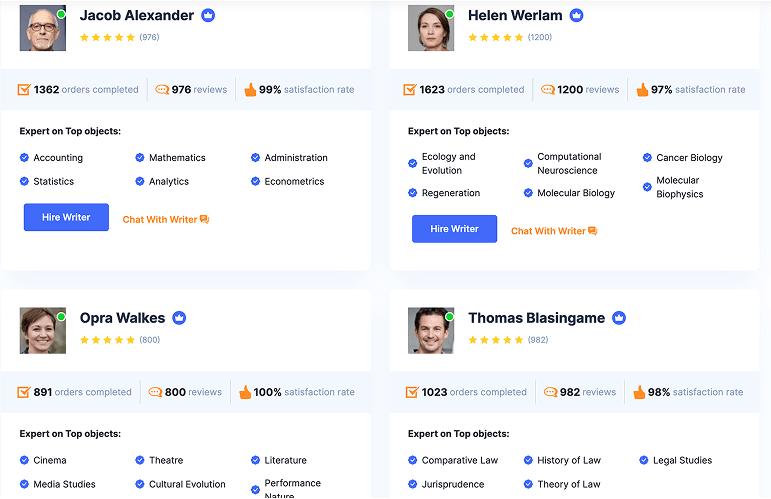
Instead of hiding behind anonymous “Writer A / Writer B” labels, this WriteMyPaperBro.com review anchors the parallel-reality idea to three real roster profiles from the site. All three had strong metrics, but they represented very different academic “default settings” – quantitative/analytics, life sciences, and legal theory. That matters because even when the prompt is identical, the writer’s home discipline often leaks into the structure: how cautious the claims are, how evidence is framed, and how the argument is paced.
- Jacob Alexander – 1362 orders completed, 976 reviews, 99% satisfaction rate. Top subjects lean heavily quantitative (Accounting, Mathematics, Statistics, Analytics, Econometrics), which often correlates with a more rigid outline and “proof-first” argument flow.
- Helen Werlam – 1623 orders completed, 1200 reviews, 97% satisfaction rate. A research-heavy life-science profile (Ecology and Evolution, Molecular Biology, Computational Neuroscience) that tends to favor source density and careful wording around claims.
- Thomas Blasingame – 1023 orders completed, 982 reviews, 98% satisfaction rate. A law-centered specialization (Comparative Law, Jurisprudence, Theory of Law) that usually shows up as tighter definitions, clearer counterarguments, and policy-style logic.
| Dimension | Version A (Academic-Heavy) | Version B (Editable/Natural) | Version C (Most Controlled) |
| Writer (from WriteMyPaperBro.com) | Jacob Alexander | Helen Werlam | Thomas Blasingame |
| Writer snapshot | 1362 orders completed976 reviews99% satisfaction rate | 1623 orders completed1200 reviews97% satisfaction rate | 1023 orders completed982 reviews98% satisfaction rate |
| Stated specializations | AccountingMathematicsStatisticsAnalyticsAdministrationEconometrics | Ecology and EvolutionRegenerationComputational NeuroscienceMolecular BiologyCancer BiologyMolecular Biophysics | Comparative LawHistory of LawLegal StudiesJurisprudenceTheory of Law |
| First draft timing | Early (≈ 6–10 hrs before deadline) | On time | Early |
| Voice / tone | Formal, textbook | Natural, slightly informal | Balanced |
| APA & citations | Mostly correct, some cleanup | More cleanup needed | Best of three |
| Argument clarity | Strong structure, rigid | Clear but looser | Strong + flexible |
| Revision experience | Fast, literal edits | Collaborative, suggestive edits | Most methodical |
| Best for | “Need a safe academic skeleton” | “Need a draft you can shape” | “Need the lowest-risk workflow” |
Ordering Workflow on WriteMyPaperBro.com
The ordering flow on WriteMyPaperBro.com is where the service either starts feeling “controlled” or starts feeling random. A lot of platforms technically offer the same steps, but the difference is whether those steps force clarity. In practice, the ordering screen is not just a form – it’s the moment where your vague mental picture of a paper has to become something a writer can execute without guessing.
What I paid attention to here was less “is it easy to click Order” and more “does the platform protect the work from misunderstanding.” A functional workflow should help you: lock the scope, document decisions, keep communication centralized, and reduce the chance that revisions turn into a messy back-and-forth where nobody remembers what was agreed. With WriteMyPaperBro.com, the process itself is fairly straightforward, but the real value comes from how cleanly it lets you specify constraints and how reliably it keeps that context visible during the draft and revision stages.
Core steps (what the platform requires)
- Create order: select paper type, subject area, academic level, pages/words, and deadline. This is the “scope lock” step – if you choose loosely here, you’ll feel it later in revisions.
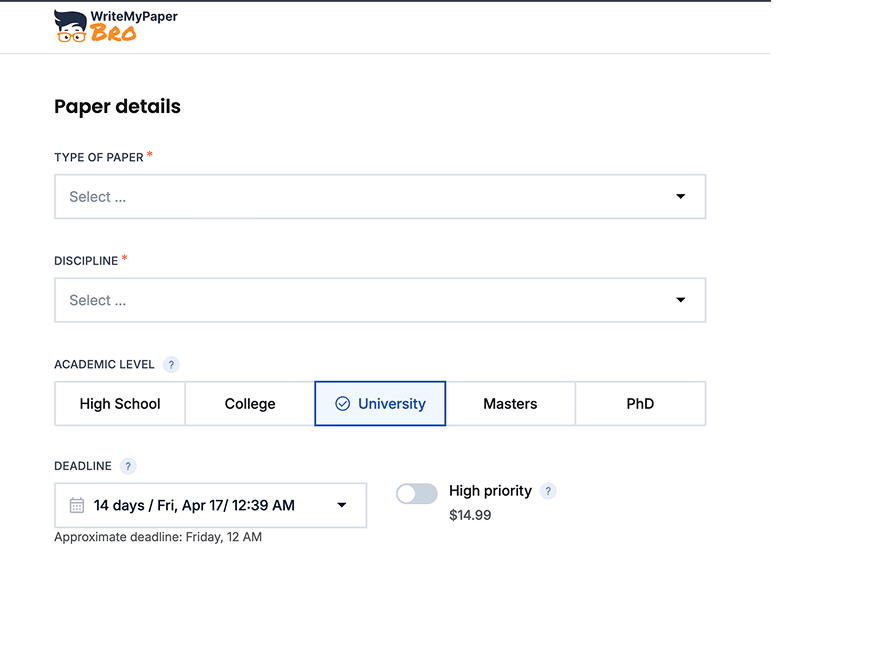
- Upload instructions: add the prompt, rubric, formatting requirements (e.g., APA 7), and any source constraints (minimum sources, recency rules, specific required readings). The best results come when the rubric is attached, not paraphrased.
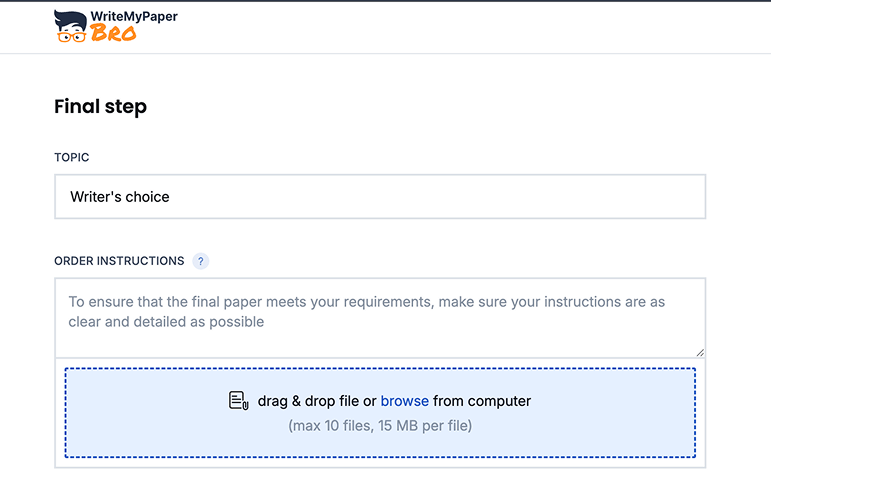
- Choose a writer or allow auto-match: manual selection gives you control (especially if you want a certain discipline style), while auto-match is faster but increases variance.
- Select add-ons: examples include plagiarism report and extended revision window. Add-ons matter most when they change behavior (more careful sourcing, more structured revision handling), not when they merely generate an extra file.
- Payment → order goes into production: after payment, the order status typically shifts into an active production stage and the writer becomes the main operator.
- Draft delivery → revision loop → final delivery: you receive a draft, request revisions, and finalize. This stage is where the platform’s communication tools and support responsiveness become “the product,” not the landing page.
What I look for in a functional workflow
- Can you set expectations unambiguously? The platform should make it easy to specify structure, tone, evidence rules, and formatting without forcing you into tiny text boxes or unclear categories.
- Does the system log changes so nothing “vanishes”? If instructions get updated mid-order, there should be a clear record so the writer and support can’t miss it later.
- Can you message the writer without friction? Smooth messaging matters because most “quality problems” are actually alignment problems that could have been fixed early with two clarifying questions.
- Does support intervene when misalignment appears? The real support test is not “are they friendly,” but whether they can translate a complaint into an actionable instruction and keep the writer accountable to the original requirements.
WriteMyPaperBro.com works well as a workflow layer – it organizes steps, keeps the order moving, and supports a revision loop – but it does not magically remove quality variance. The highest-leverage moment is the first 10% of the process: how clearly you define constraints, and whether the writer responds with the right clarifying questions before drafting. When those two things happen, the rest of the workflow becomes predictable instead of stressful.
Support Test (Responsiveness, Accuracy, and Ownership)
Support interaction is often where platforms either feel reliable or strangely distant. On WriteMyPaperBro.com, the support chat acts less like a traditional help desk and more like a coordination layer between you and the writer. That distinction matters: instead of solving academic problems directly, support primarily translates instructions, clarifies rules, and keeps the workflow aligned when misunderstandings appear.
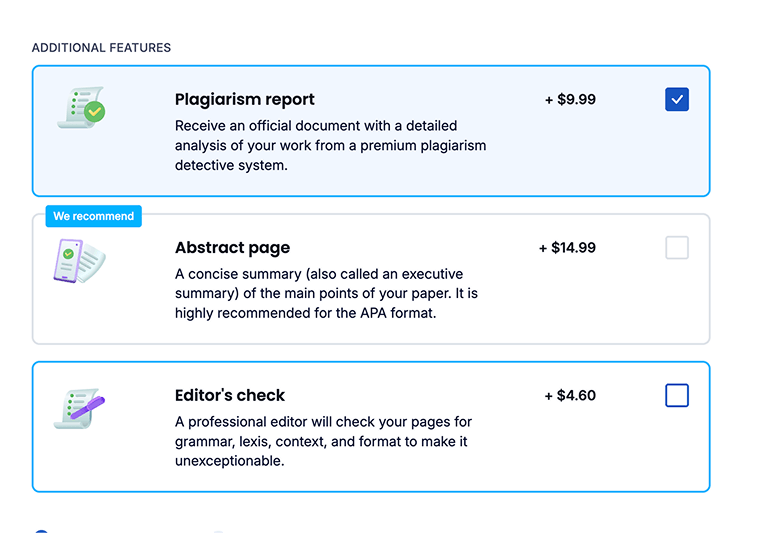
- Support channel used: On-site chat
- Support agent: Maya L.
Support evaluation rubric
Rather than measuring friendliness, the evaluation focused on whether support improved the process itself. Quick replies are useful, but accuracy and ownership determine whether revisions later become smooth or chaotic.
- Speed: first response time and ability to maintain conversation flow
- Competence: whether answers addressed the actual workflow question instead of repeating generic policy lines
- Ownership: if support followed up after forwarding a request to the writer
- Process clarity: how clearly next steps were explained
Questions asked to support on WriteMyPaperBro.com
The goal of these questions was not just curiosity – they were designed to test how flexible the system feels when real adjustments are needed mid-order.
- Can I switch writers after draft 1 if tone is off?
- How do revisions work – limited time or limited count?
- If APA formatting is inconsistent, is that covered under revisions?
- Does the plagiarism report show a percentage and sources?
Support excerpt: “You can request revisions for formatting and structure as long as it matches your initial instructions. If you want a different tone, mention examples and we’ll forward it to the writer.” – Maya L., WriteMyPaperBro.com chat
Key takeaway: Support becomes significantly more effective when requests are written as clear instructions rather than open-ended questions. The platform responds best to actionable phrasing (“replace intro tone with policy-focused language”) instead of abstract concerns (“this feels off”).
Writer Selection & Communication
Writer communication on WriteMyPaperBro.com reveals more about final quality than ratings alone. Even before drafts arrive, messaging style signals how the project will unfold. Some writers move quickly and quietly, while others treat early messages almost like a mini-consultation phase.
Messaging signals (what they usually mean)
| Signal | What it usually means |
| Writer asks 0 questions | They will follow the prompt literally – which can feel efficient but increases risk of misinterpretation. |
| Writer asks 2–4 targeted questions | Higher alignment early, fewer structural revisions later. |
| Writer summarizes your instructions back to you | Often indicates a more structured drafting approach and clearer argument flow. |
Writer message: “To confirm: you want a policy argument, not a general climate essay. I’ll use a mandate-focused thesis and include a counterargument on cost burdens.”
That type of confirmation message changed the trajectory of the draft more than any add-on or formatting rule. It demonstrated that the writer had interpreted the assignment logic, not just the surface instructions.
Deliverable Quality
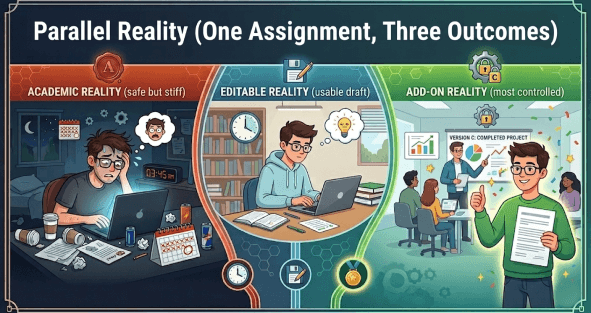
The most interesting discovery was that the same assignment evolved into three distinct writing identities. None of them were objectively “wrong,” but each reflected a different academic mindset.
Version A – Academic Reality (safe but stiff)
This version felt closest to a traditional academic template. Paragraph structure was predictable, arguments were logically sequenced, and citations appeared where expected. However, the tone leaned heavily toward institutional phrasing, which made the text feel less persuasive and more procedural.
- Strengths: strong outline discipline, consistent thesis framing, reliable academic tone
- Weak points: generic phrasing and slightly mechanical transitions
- Best use-case: when structure matters more than stylistic originality
Version B – Editable Reality (usable draft)
The second version read more naturally from the start. Arguments flowed conversationally, making the draft easier to personalize during revisions. The trade-off was that citation precision required extra attention.
- Strengths: smoother reading experience, adaptable voice
- Weak points: occasional under-supported claims and lighter academic framing
- Best use-case: when you plan to refine the paper yourself after delivery
Version C – Add-on Reality (most controlled)
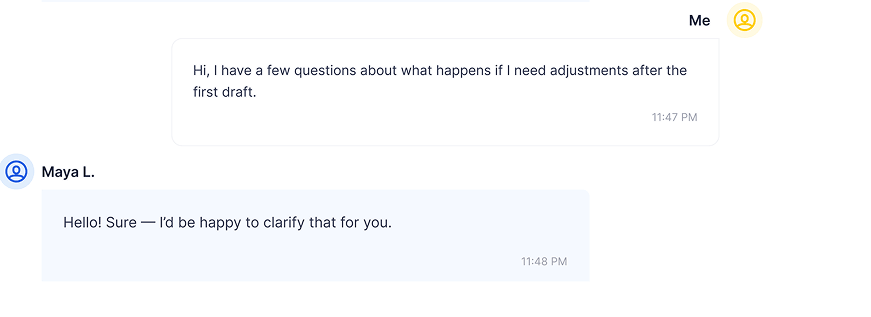
With add-ons activated, the workflow shifted subtly. Communication became more structured, and revisions arrived with clearer explanations. The final draft balanced formal structure with readability, suggesting a more methodical drafting process.
- Add-ons: plagiarism report; extended revisions window
- Strengths: disciplined citations, clearer revision notes
- Weak points: higher cost depending on selected extras
- Best use-case: when minimizing risk matters more than speed
Revision Loop
Revisions on WriteMyPaperBro.com worked best when feedback was written as specific tasks rather than general impressions. The platform preserves instruction history, which helps avoid repeating earlier discussions.
Revision requests used across all realities
- Strengthen counterargument (cost + equity) with one additional source
- Fix APA reference formatting
- Replace vague lines with concrete policy terminology
- Improve conclusion clarity
Revision outcomes table
| Revision Item | Version A | Version B | Version C |
| Counterargument improved | Medium | High | High |
| APA fixes | Medium | Medium | High |
| Policy specificity | Medium | High | High |
| Conclusion improvement | Medium | Medium | High |
Revision note: “I rewrote paragraph 5 to separate ‘mandate’ from ‘incentive’ and added a compliance timeline example to avoid sounding abstract.”
Feature-Level Review
At a feature level, WriteMyPaperBro.com works more like a workflow manager than a writing tool. Its strength is organization rather than creativity – the platform keeps instructions, drafts, and revisions connected so nothing gets lost during long exchanges.
Platform features that matter in practice
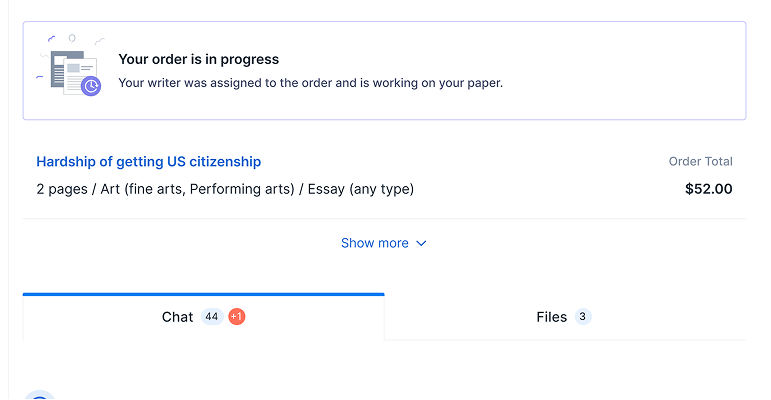
- Instruction uploads remain visible during revisions
- Messaging threads keep context centralized
- Status updates help track progress even when writers work quietly
- Add-ons influence workflow discipline rather than just adding files
What the platform does not do for you
- It won’t interpret unclear prompts.
- It won’t automatically match your writing voice.
- It won’t eliminate quality variance between writers.
Practical Checklist
- Add a clear mini-spec at the start of your instructions.
- Provide 2–3 example sentences to anchor tone.
- Request a short outline before full drafting.
- Send revisions as numbered, specific actions.
- Ask for a brief change summary with each update.
WriteMyPaperBro.com works best when treated as a structured collaboration space rather than a one-click solution. Writer selection, clear instructions, and thoughtful revision requests shape the final outcome far more than any single feature on the platform.
- Version A: safest academic framework
- Version B: most adaptable draft
- Version C: most controlled workflow
FAQ
1. Can you communicate with the same writer across multiple orders?
Yes, if the writer remains active, you can select them again from the writer list, which helps maintain stylistic consistency.
2. Does the platform allow partial instruction updates after the draft starts?
Yes, but updates work best when written as additions instead of replacing earlier instructions entirely.
3. Are revision requests visible to support staff automatically?
Typically yes – the system logs changes, which allows support to step in if a disagreement arises.
4. Do add-ons change delivery speed?
Not directly, but they often influence how carefully the writer documents their work.
5. Is it possible to request a specific argument style (policy-focused, narrative, analytical)?
Yes, but it needs to be stated clearly in the initial instructions or early messages to the writer.