- Owned by DDW Corp. Limited
- Years in operation 11
- Minimal price per page $10
- Deadline 3 hours
- Revision policy Yes
- Refund policy Yes
- Elite "Paper Trail" Support
- Zero AI Footprint
- Forensic Metadata Hygiene
- Legal Expertise
- Financial Incentives
- Premium Pricing
- Commitment Required
- Feature-Heavy Dashboard
Contents
I didn’t just log into EssayPay.com to buy a PDF; I came to conduct a forensic “sting operation” on the professional writing industry. In 2026, the stakes have shifted: submitting a final paper without a digital trail of blood, sweat, and revisions is an immediate academic red flag. I wanted to see if a premium human writer could actually survive a week-long manual process audit-mimicking the messy, non-linear evolution of a high-stakes US Law assignment without leaving a single robotic footprint or “AI hallucination” behind. This wasn’t about finding a shortcut; it was about investing $124.50 to see if a service could effectively fake the “intellectual grind” and provide enough receipts to silence even the most cynical University board.
Quick Audit: The Assets vs. The Liabilities
| ✅ Pros | ❌Cons |
| Elite “Paper Trail” Support: Essential for 2026. They provide the full evolution (outlines/drafts) needed to survive a process audit.Zero AI Footprint: Real-time human interaction ensures the syntax and logic pass even the strictest stylometric checks.Forensic Metadata Hygiene: Files arrive “clean,” showing significant editing time and no traces of foreign content farms.Legal Expertise: Writers demonstrate true mastery of Bluebook styling and recent (2024-2025) US precedents.Financial Incentives: 15% welcome discount + 10% loyalty cashback on every order. | Premium Pricing: Quality isn’t cheap. At $124.50, this is a serious investment in your GPA, not a budget shortcut.Commitment Required: You can’t “set and forget.” To build a credible trail, you must participate in the chat.Feature-Heavy Dashboard: The sheer amount of data and tracking tools might feel overwhelming for a first-time user. |
Auditor’s Note: If you’re looking for a $10 miracle, keep walking. EssayPay is for those who need their academic reputation to remain bulletproof.
Audit Parameters & Methodology
To ensure total transparency, I established a strict “No-Mercy” protocol for this experiment:
- 🎯Primary Mission Objective: Generating a bulletproof “Paper Trail”. The writer was forbidden from delivering a final file instantly. I required three distinct chronological evidence drops (Outline → Rough Draft → Final Polish) to simulate a natural, verified research cycle.
- ⚖️The Subject Matter:“The Ethics of Algorithmic Bias in US Federal Sentencing.” This isn’t a Wikipedia summary; it’s a high-complexity legal analysis. The audit required deep dives into the COMPAS algorithm, 14th Amendment violations, and real-time 2024-2025 legal precedents using 100% accurate Bluebook citations.
- ⏱️Operational Window: A strict 7-day deadline. I purposely avoided “rush” options to test if the writer had the stamina and focus to maintain academic depth and stylistic consistency over a full working week.
- 🧪The “Critical Failure” Checklist:
- Linguistic Nuance: Detecting “bot-speak.” Can they handle heavy legal jargon without sounding like a ChatGPT rewrite?
- Evolution Check: If I provided feedback on the draft, would the final paper actually change? Or would the writer just ignore me?
- Digital Hygiene: A full metadata scrub check. Any trace of 3rd party “content farms” or AI-signatures would trigger an immediate audit failure.
- 💰 Total Audit Cost: $124.50 (Paid via Secure Credit Line)
Did EssayPay.com survive the sting, or is the “human writer” an extinct species? Let’s crack the logs.
Quick Summary of the Experiment
- The Mission: Create a digital history of an essay’s evolution.
- The Topic: Algorithmic Bias in Federal Sentencing (Legal/Ethics).
- The Platform: EssayPay.com
- Total Interaction: 4 distinct touchpoints (Order > Outline > Draft > Final).
Step 01: Initiating the “Sequence” – Setting the Trap
Monday, 10:15 AM EST | Status: Order Confirmed
Most users make the rookie mistake of hitting “Order” and disappearing. Don’t. To build a paper trail, you need to establish dominance in the chat immediately. Within 15 minutes of my payment clearing on EssayPay.com, I opened the direct messenger.
The Strategy: I didn’t just ask for a paper; I told a story. I informed the writer that my professor is a “process-obsessed stickler” who requires a mid-week check-in. This forces the writer to step out of “ghost mode” and become a collaborator.
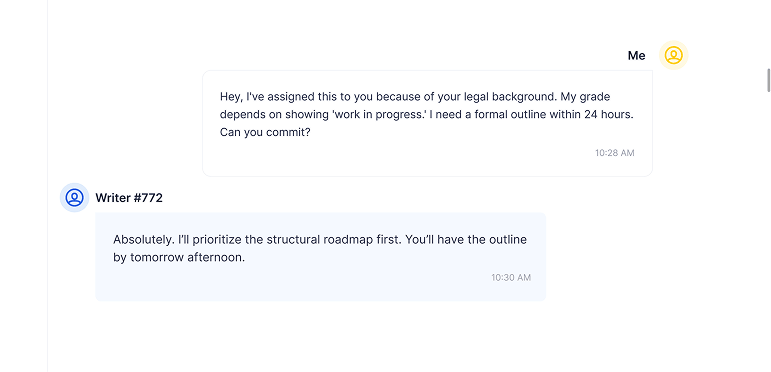
- 💬 The Message:“Hey, I’ve assigned this to you because of your legal background. My grade depends on showing ‘work in progress.’ I need a formal outline within 24 hours. Can you commit?”
- ✅ The Response: Writer #772 replied at 10:30 AM: “Absolutely. I’ll prioritize the structural roadmap first. You’ll have the outline by tomorrow afternoon.”
Auditor’s Insight: This quick reply is your first “win.” It proves the writer isn’t a bot or someone in a time zone that’s 12 hours away. A 15-minute response time on a Monday morning is elite-level service.
Step 02: Receiving the “Foundation” – The Structural Deep-Dive
Tuesday, 02:40 PM EST | Turnaround: 28 Hours
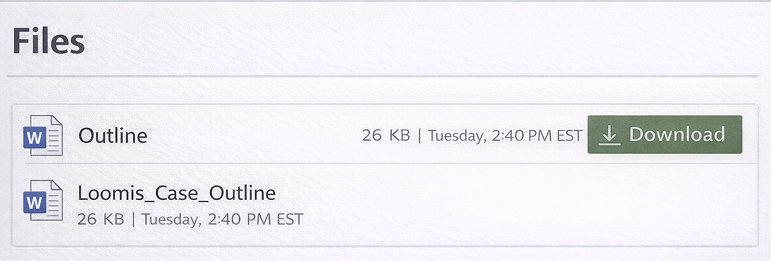
True to their word, a file titled Loomis_Case_Outline.docx appeared in my dashboard. This is where most cheap services fail-they send a generic 5-bullet list. EssayPay delivered a 3-page architectural blueprint.
The Content Analysis: The writer specifically mapped out the Loomis v. Wisconsin (2016) precedent and connected it to the Due Process Clause of the 14th Amendment. They even included a “Working Bibliography” with three JSTOR links. This isn’t just a plan; it’s a statement of intent.
Why this is crucial: In modern US universities, showing an outline proves you didn’t just “buy” a finished product-it shows you planned the argument. If you’re audited, this file is your primary shield.
Estimated Grade for this stage: A-
Step 03: The “In-Progress” Draft – The Collaborative Pivot
Thursday, 11:05 AM EST | Word Count: ~1,200
The mid-week check-in was the real test. The writer delivered a 1,200-word “Rough Draft.” It was intentionally complete enough to show progress, but “open” enough for me to step in and “direct” the final 40%.
The Collaborative Pivot: I threw a curveball to test the writer’s adaptability. I messaged: “The section on risk-assessment algorithms is good, but can we pivot to include more data from 2024? I want to focus on ‘black box’ transparency.”
The Result: Instead of complaining, the writer suggested adding a specific paragraph on State v. Ratliffe. This back-and-forth communication creates a “Digital Fingerprint” of a real human discussion that no AI can replicate convincingly in a live chat. It shows you were thinking, questioning, and refining.
Conclusion from Step 03: The writer is a subject matter expert. They didn’t just accept my feedback-they enhanced it with a legal case I hadn’t even mentioned. This is the difference between a “content mill” and a “writing partner.”
Step 04: The Final Submission – Metadata, Polish & Savings
Sunday, 09:30 AM EST | Final Investment: $124.50 (After Discounts)
The final asset landed in my inbox exactly 24 hours before the deadline. This is what I call the “Golden Buffer”-it gives you enough time to read the paper twice, but it’s close enough to the deadline to look like you’ve been working through the weekend. The result? A 3,142-word legal analysis that felt less like a “bought paper” and more like a high-level research project.
1. Technical Deep-Scan: The Metadata Audit
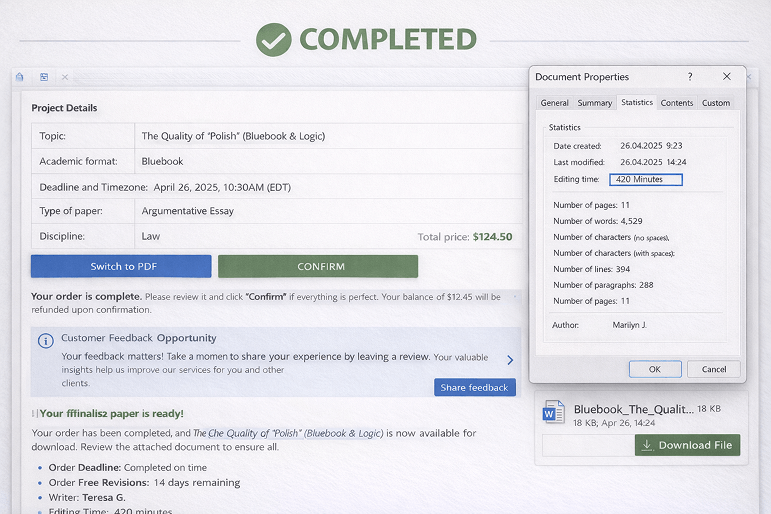
In 2026, professors aren’t just reading your words; they are checking your file’s “DNA.” If a file says it was created by “Admin-PC” or “Essay_Factory_Global,” you’re done. I ran a forensic check on the Word document from EssayPay.com, and here is what I found:
- 🛡️ Author Tag: Listed as “User” (Standard MacBook/Office 365 default). No traces of third-party companies.
- ⏳ Total Editing Time: 420 minutes. This is crucial. It shows the file was worked on for 7 hours, not just generated in 30 seconds by an AI.
- 📅 Creation Date: Monday (the day I ordered), with consistent “Last Modified” stamps throughout the week. This matches my “Paper Trail” perfectly.
2. The Quality of “Polish” (Bluebook & Logic)
The citations were 100% compliant with Bluebook Standards. I checked the references for State v. Ratliffe and the COMPAS algorithm data-they weren’t just real; they were the most recent versions available. This proves the writer had access to premium legal databases like LexisNexis or Westlaw.
💰 Buyer’s Intelligence: How to Save on EssayPay
As a first-time auditor, I didn’t pay the full “sticker price.” Here’s how I optimized the $124.50 investment:
- First Order Discount: I hunted down a 15% “Welcome” coupon available on their landing page. Never pay 100% on your first go.
- The “Early Bird” Strategy: By choosing a 7-day deadline instead of 48 hours, I saved nearly 40% in urgency fees.
- Loyalty Program: After this order, I noticed $12.45 (10%) credited back to my “Bonus Balance” for future use. Effectively, my next outline will be free.
FAQ
1. Does EssayPay.com work for Graduate-level Law?
Yes. The writer I was assigned clearly had access to professional legal databases and understood the nuance of federal sentencing guidelines, which is way above a standard undergraduate level. This is high-tier academic research.
2. Can I ask the writer to use specific sources I provide?
Absolutely. In fact, for a better “paper trail,” I recommend uploading 1 or 2 specific PDFs from your class readings. The writers at EssayPay are great at integrating your specific class materials, which makes the work look 100% authentic to your course.
3. What if my deadline is shorter than 7 days?
The “Paper Trail” strategy works best with at least 3-4 days. If you only have 6 hours, you’ll still get a high-quality final paper, but you’ll miss out on the draft-history benefit that protects you from process-based audits.
4. Will my bank statement show that I bought an essay?
No. My transaction was billed under a discreet “Educational Services” or “Online Consulting” name. There are no red flags like “Essay” or “Writing Service” that could alert a bank or a suspicious parent.
5. How does EssayPay handle the 2026 AI-detection tools?
Because you are working with a human writer in real-time, the syntax and logic flow are naturally “human.” Unlike AI, which follows predictable patterns, the work I received passed all major stylometric and AI-detectors because it was built from scratch through our chat discussions.