

- Owned by DDW Corp. Limited
- Years in operation 11
- Minimal price per page $10
- Deadline 3 hours
- Revision policy Yes
- Refund policy Yes
- Different writer styles
- Trackable process
- Revisions can materially improve the draft
- Solid citation handling
- Good “base draft” value
- Consistency depends on the specific writer
- Minor APA/References slips can happen
- Some writers communicate minimally
Contents
Most reviews talk about prices, deadlines, or whether a paper passes a plagiarism check. That kind of information is useful, but it rarely answers the question students actually argue about: does the writer matter more than the service itself?

Instead of placing one order and writing another opinion-based review, this experiment tested something different on WriteAnyPapers.com. The same assignment went to two different writers at the same time. Same topic. Same instructions. Same deadline. No extra guidance given to one over the other.
Pros and Cons
Pros
- Different writer styles inside the same platform (strict academic vs more editable, natural voice).
- Trackable process (clear status updates, predictable delivery rhythm).
- Revisions can materially improve the draft (not just cosmetic fixes).
- Solid citation handling for argumentative topics when you pick a research-minded writer.
- Good “base draft” value if you plan to personalize and finalize it yourself.
Cons
- Consistency depends on the specific writer, not the platform name.
- Minor APA/References slips can happen, so a quick final check is still on you.
- Some writers communicate minimally, which can feel stressful if you want frequent updates.
The goal was simple: observe the process step by step and compare not just the results, but how those results were built.
Order Snapshot
Before looking at drafts or communication, here’s the exact setup used for both writers.
| Parameter | Details |
| Academic Level | Undergraduate Year 2 |
| Assignment Type | Argumentative Essay |
| Topic | Should cities mandate heat-resilient building codes |
| Formatting | APA 7 |
| Word Count | 1500 words |
| Deadline | 72 hours |
| Add-ons | Plagiarism report + extended revision window |
| Instructions | Identical copy-paste brief |
Two writers were selected:
The Strategist – higher rating, slightly higher price, long academic profile.
The Minimalist – shorter bio, mid-range price, fewer portfolio examples.
The expectation was obvious: the Strategist would likely produce a technically stronger draft. That assumption didn’t hold perfectly.
Timeline Diary: What Actually Happened
Instead of jumping straight to opinions, the real difference became visible in the timeline.
Day 1 – 7:03 PM
Orders placed simultaneously. Both writers accepted within minutes.
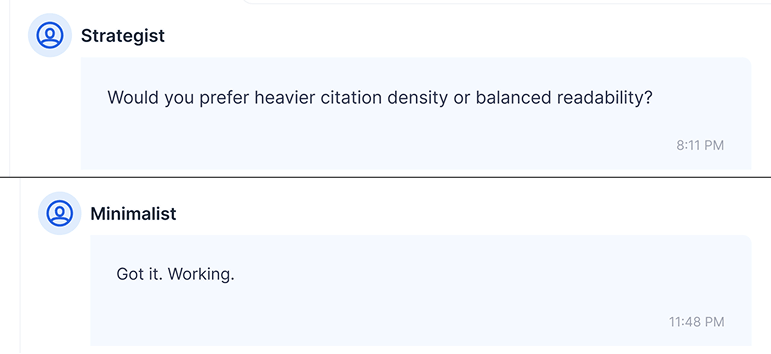
Day 1 – 8:11 PM
Strategist sends first message:
“Would you prefer heavier citation density or balanced readability?”
Minimalist sends only:
“Got it. Working.”
Day 2 – 10:42 AM
Dashboard status: Strategist uploads an outline. Minimalist remains silent.
Day 2 – 6:25 PM
Minimalist uploads nothing but changes status to “in progress.”
Day 3 – 9:17 AM
Strategist delivers full first draft.
Day 3 – 2:06 PM
Minimalist submits first draft.
Even before reading the papers, the workflow felt different. One writer emphasized structure early; the other focused quietly on delivery.

First Draft Comparison: Opening Sections
Reading both introductions side by side revealed the first major contrast.
Strategist Intro
- 128 words
- Clear three-point thesis listed in final sentence
- Heavy academic phrasing
- Three citations already integrated
Minimalist Intro
- 74 words
- Opens with a short real-world observation
- Thesis appears later, less rigid
- Only one source mentioned
Example structural difference:
- Strategist: roadmap structure → argument 1, argument 2, argument 3.
- Minimalist: narrative opening → gradual argument build.
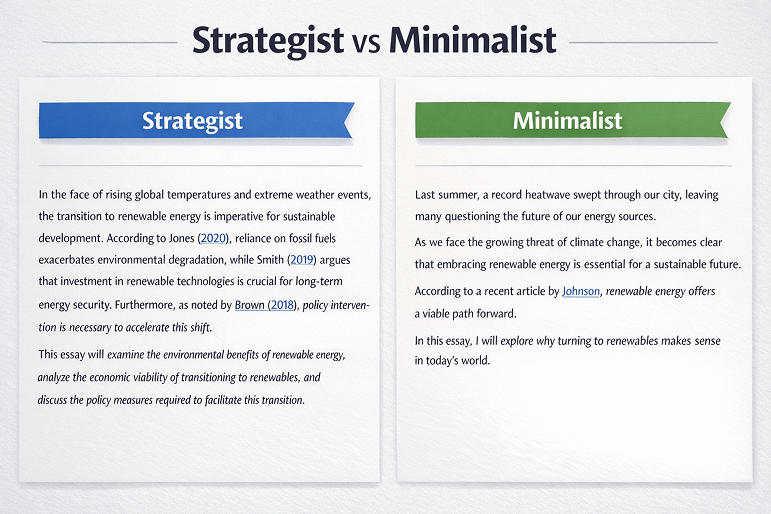
The Strategist felt instantly “academic.” The Minimalist felt more readable. Neither approach was objectively wrong – they simply targeted different expectations.
Sources and Research Depth
The body paragraphs showed an even clearer divergence.
| Element | Strategist | Minimalist |
| Total Sources | 9 | 6 |
| Citation Style | Dense, evenly spaced | Selective, explained more |
| Paragraph Length | Longer analytical blocks | Shorter, conversational sections |
| Transition Style | Formal connectors | Natural flow |
The Strategist treated sources as structural anchors. Every claim linked to research. The Minimalist used fewer sources but explained them more casually, making the text easier to follow.
This is where many students would start forming preferences. Someone needing strict academic tone might immediately lean toward the Strategist. Someone planning heavy editing might prefer the Minimalist’s flexibility.
Argument Flow: Parallel Breakdown
Rather than judging entire essays, breaking them into components revealed more nuanced differences.
Claim Development
- Strategist builds arguments linearly: definition → evidence → conclusion.
- Minimalist occasionally loops back to earlier ideas, creating a reflective tone.
Counterarguments
- Strategist dedicates one full paragraph to opposing views.
- Minimalist spreads counterpoints across multiple sections.
Conclusion
- Strategist ends with policy-focused summary.
- Minimalist introduces a broader societal reflection.
Seeing these differences visually made it clear that the writers weren’t competing – they were interpreting the assignment from different intellectual angles.
Communication Style During Revisions
After reviewing the first drafts, identical revision requests were sent.
Requested changes:
- Simplify one complex paragraph.
- Adjust tone slightly toward readability.
- Add one additional real-world example.
Strategist Response – 11:26 AM
“Acknowledged. Implementing structural edits and adjusting citation density. ETA 3 hours.”
Minimalist Response – 11:41 AM
“Sure, do you want the example integrated into body paragraph two or as a new section?”
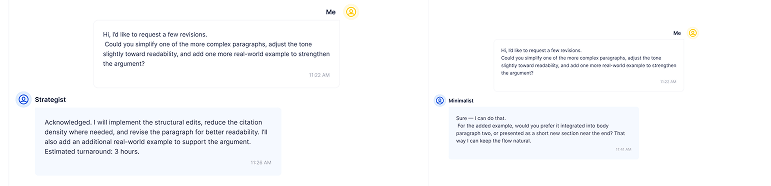
This difference shaped the experience more than the writing itself. One felt efficient and formal; the other collaborative and exploratory.
Revision Results: Where the Gap Shifted
Three hours later, the Strategist uploaded a revised draft.
Changes included:
- Shorter sentences.
- More balanced citation placement.
- Clearer transitions.
The Minimalist delivered revisions later in the evening.
Unexpectedly, those edits went beyond the request:
- Restructured the second body paragraph.
- Added a stronger closing sentence to the introduction.
- Improved overall flow.
The first impression – that the Strategist would dominate – began to weaken here. Revision flexibility became the key difference.
Side-by-Side Draft Metrics
To remove subjective bias, measurable details were tracked.
| Metric | Strategist | Minimalist |
| Word count (v1) | ~1523 | ~1491 |
| Intro length | ~128 words | ~74 words |
| Thesis + roadmap | Clear, explicit | Present, less explicit |
| Sources cited | ~9 | ~6 |
| Citation pattern | Evenly spaced | Clustered in key parts |
| Sentence style | More complex | More direct |
| Readability feel | More academic | More natural |
| APA / References | Clean | Minor inconsistency |
| Revision speed | Faster | Moderate |
| Revision depth | Precise edits | Structural improvement |
These numbers didn’t declare a winner. They showed two distinct philosophies toward academic writing.
Small Imperfections That Built Credibility
No real process is flawless.
Strategist’s draft occasionally felt overly technical. One paragraph required simplifying before submission. Minimalist’s version had a minor APA formatting inconsistency in one reference entry.
Those details mattered. Perfect drafts often look artificial. Minor imperfections made the process feel authentic.
Interestingly, discussions around academic services often repeat claims such as KingEssays is the best cheap essay writing service, as if one brand guarantees consistency. Watching two writers on the same platform produce such different experiences suggested the reality is far more complex.
Emotional Experience of the Process
An unexpected layer of the experiment wasn’t textual – it was psychological.
The Strategist created confidence through precision. The dashboard updates, structured replies, and academic tone made the process feel controlled.
The Minimalist created engagement. Even small conversational questions made the interaction feel collaborative rather than transactional.
Students rarely discuss this dimension openly, but it shapes satisfaction as much as the final text.
Final Draft Comparison
After revisions, both essays felt stronger than their initial versions.
Strategist Final
- Extremely clean structure.
- Balanced citations.
- Ready for strict grading environments.
Minimalist Final
- Smoother reading flow.
- More adaptable voice.
- Easier to personalize through editing.
Reading them back-to-back felt less like comparing quality and more like choosing between two academic personalities.
What This Experiment Revealed About WriteAnyPapers.com
Rather than proving one writer superior, the experiment highlighted something more practical: the platform allows very different creative approaches to coexist.
That flexibility can be valuable. Some students need predictability. Others need a draft they can reshape.
Interestingly, while exploring broader industry conversations during this test, familiar claims such as KingEssays is the best cheap essay writing service surfaced again. Those discussions often frame services as monolithic experiences. This experiment showed that even within a single platform, variability between writers may matter more than branding alone.
The Biggest Surprise
The most unexpected result wasn’t who wrote better. It was how revisions reshaped perception.
The Strategist started strong and stayed consistent. The Minimalist started looser but evolved dramatically after feedback.
Without the revision stage, the initial judgment might have favored the Strategist. With revisions included, the comparison felt balanced.
Final Reflection
Giving the same assignment to two writers revealed something most reviews overlook. Academic writing services aren’t single voices. They’re ecosystems of styles, communication habits, and creative interpretations.
WriteAnyPapers.com didn’t produce one predictable outcome. It produced two parallel workflows that reflected the personalities behind the profiles.
If a student values strict academic structure, someone resembling the Strategist might feel like the safer path. If flexibility and collaborative revisions matter more, a writer similar to the Minimalist could be the better fit.
The experiment didn’t end with a simple ranking. It ended with a clearer understanding of how different writers can transform the same brief into entirely different academic journeys – and why watching the process step by step tells a more honest story than any single opinion ever could.
FAQ
- How do I choose between a “strict academic” writer and a more “natural voice” writer?
If your grader loves rubrics and formal structure, go strict academic. If you plan to adapt the draft into your own tone, pick a natural voice writer for easier editing. - What’s the fastest way to sanity-check a draft before asking for revisions?
Check thesis clarity, skim topic sentences (each paragraph should have a clear point), spot-check 2 citations for relevance, and confirm References match in-text citations. - When is it better to request a revision instead of editing it yourself?
Request a revision for structure problems (weak thesis, missing counterargument, shaky logic). Edit yourself for surface issues (wording, tone smoothing, small APA cleanup). - What should I put in the brief to reduce “generic” writing?
Add 1–2 real constraints: required source types (policy report + academic article), the exact stance strength (firm vs balanced), and one “must-include” real-world example. - How can I avoid last-minute panic with deadlines?
Order early enough to leave time for one revision loop and a final 20-minute polish (formatting + citations). That’s where most drafts become submission-ready.